

Over my years at Auth0 I had the opportunity to interview, hire and grow a lot of people. Ever since, I’ve seen some of them grow to become leaders at the company, while others kind of “stayed still”. A thing I always looked for when hiring folks was how fast they learned new things, and how much they liked to learn:


But while I’ve come to the conclusion that learning fast is one important characteristic of successful startup hires, there is a more general principle (and a lot more literature on it): hiring antifragile people.
A quick primer on antifragility
Antifragility is a concept Nassim Nicholas Taleb introduces and explains in depth in the book Antifragile: Things That Gain from Disorder. The premise is that some things (including people) improve from stressful situations. A simplification of it can be the saying "what doesn't kill me makes me stronger".
Taleb categorizes things into 3 categories:
Fragile: loses from disorder (and/or volatility, uncertainty)
Robust: neither gains nor loses from disorder
Antifragile: gains from disorder
Disorder at startups
If you've worked at a startup (or read the stories about it) you know disorder is the rule. Let's go over some common sources of disorder and uncertainty at startups:
People have to wear multiple different hats, being more comfortable with some (e.g.: an Engineer doing support for a tech product) than others (e.g.: an Engineer reviewing SLAs in legal contracts).
Frequent re-organizations: startups typically reorganize their teams every 6-12 months (depending on many things, like growth rate, market focus, etc.) People don't know what they'll work on 6 months from now, who they'll report to, etc.
Finding product market fit (PMF) requires exploring multiple ways to approach a product (and perhaps multiple products) in short periods of time.
Priorities change often as new discoveries are made, contracts with clients might require features, systems become unstable from load, etc.
There's usually little (or no) internal documentation as teams move fast. Whatever documentation is available is typically outdated.
And many more…
At Auth0 we used to tell every interviewee that a big key to success was not just “being OK with change" (i.e. being robust to change, neither win nor lose), but “enjoy change”.
It's also important to realize that it is not necessarily good to not have the above sources of disorder:
Frequent re-organizations might just mean that the company successfully moved from one stage to the next and learned some things that are believed to make it more successful.
Stating the obvious: as a startup, it is better to have a successful product with outdated internal documentation than an unsuccessful product with up-to-date internal docs.
Startup disorder and how it impacts people
Given the aforementioned stressors and our definitions for fragile and antifragile, we can imagine and categorize outcomes to different situations: either the person loses or gains “value/skills”.
Stressor 1: incident in production because of a database issue
Loses: does not participate to fix the incident (misses learning opportunity), complains the day after that another team “made a mistake” behind their back.
Gains: helps fix the incident and learns from it. after the incident learns best practices for incident response and reads up on the internals.
Stressor 2: reorganization/changes teams and focus
Loses: gets demotivated because they only wanted to work on their original team/problem
Gains: quickly starts learning new domain, offers to remain in touch with team owning previous systems to help them and stay up to date
Stressor 3: priorities change because a feature was promised to a customer as part of a new contract
Loses: complains, shares complaints with team. Gets demotivated. Asks to be changed to a team where this happens less often.
Gains: asks questions to understand importance of the customer, figures out how the business is affected (positively/negatively by this).
A few things of note:
The same person will not always gain or lose from any stressor, even similar stressors (e.g. two different incidents).
Each loss and gain is not of equal "size". E.g.: feeling demotivated at work for 6 months could be thought of as a big loss, whereas an engineer improving their legal skills could be a small win.
We are not including external stressors.
Different people find different things "stressing". The same people that might be antifragile to startup disorder might be extremely fragile (e.g.: get demotivated) by big company stressors such as large interminable meetings and the quarterly planning exercise.
The interesting thing is that the way we are defining losses and gains is entirely up to the individual. They decide.
The benefits of antifragile startup people
Over time, due to continued exposure to a startup’s disorder, a person that can consistently get the gains will improve their value/skills. Moreover, I think those skills compound in value. If skill A has value 2 and skill B has value 3, a person that can do both has a value > 5 (particularly if either A or B are knowledge about the specific startup). As Naval puts it:

Pseudo-mathematically, if x is a variable representing the startup stressors and they happen over time, we can use t (time) as proportional to x. f(t) are the skills (or value the person has for the startup) we can imagine the following growth for the person.
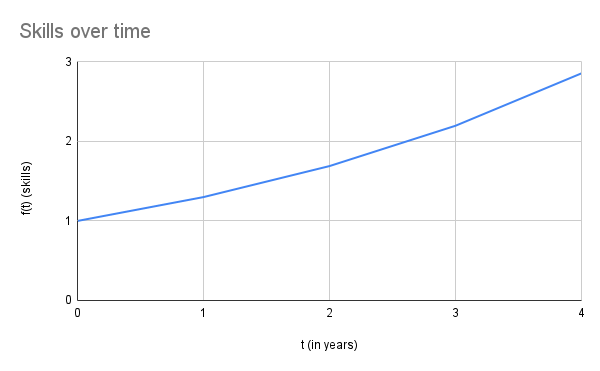
While learning compounds it might suffer from the law of diminishing returns after a few years. In this case, the person continues to grow but more slowly. If and when those diminishing returns start depends on the context, company, person, and a lot more things.
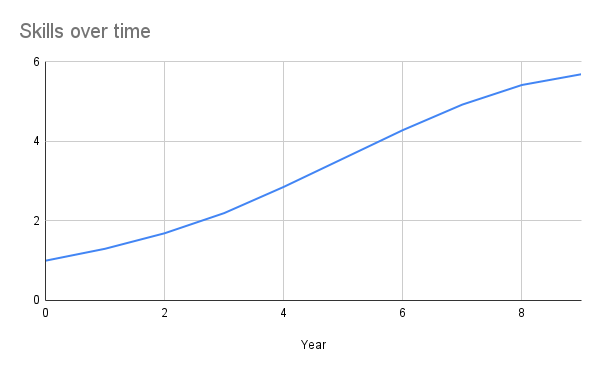
All of this is very similar to the notion of learning I stated in my tweet: we want people that grow fast. However, we now have one mental model of how these people grow. From all the available content (blog posts, videos, books, etc.) we know the kind of stressors/disorder they’ll be subject to and have examples of how they’ll need to grow from those examples.
Spotting antifragile startup people
Some things you can do during the hiring process to detect if someone will be antifragile to startup disorder:
They like and thrive in change: look at their past experience and see what they looked to do outside the box. Did they change roles within a company to try something else out? Did they contribute to teams other than their own? Do they talk about it in a positive light?
They don't make excuses: test to see if they own their part in past mistakes and explain how it was a learning opportunity for them.
They take feedback well and proactively ask for it: politely give them feedback about something you disagree with (or pretend to) during an interview or a take-home exercise. What do they do? How do they react? Do they ask for feedback after an interview/take-home exercise?
They handle ambiguity well: give them open interview problems or take home exercises. They should ask good questions and be OK getting a feel for the terrain without handholding.
They proactively research the company and the team: it's part of their instinct to learn by themselves. They don't wait for interviewers to tell them what the company is like. They do their own research. Look for evidence of this in the past and during the process (e.g. take-home exercise).
They have a growth track record: this beats people from big companies that have not grown there. Dig deep for it.
A lot of the recommendations above involve take-home exercise with ambiguity and opportunities to provide feedback. I highly recommend that. You can read more about how we did this early on at Auth0.
What if I don't get these antifragile people early?
You are in trouble. Here's why: because of how compounding works, you can't find enough of these people in the job market. As your startup grows, internal knowledge is private, and general knowledge is specific but not as many people as you need out there specialize and in exactly what your company does.
If your company is successful it will likely grow in headcount (although this is not a must like Whatsapp's case) challenging projects, customer size, etc.
You need those experts, those early compounders to lead big initiatives, teach others, sell those big deals! If you don't have them, you end up being slower, MUCH slower than you would. And slow gets you killed. As Sam Altman puts it:

This is such an underrated hiring lens. Early stage teams need people who get stronger when things break, not people who need perfect conditions to perform. The best early hires I’ve seen are the ones who treated every fire drill as a learning opportunity.